
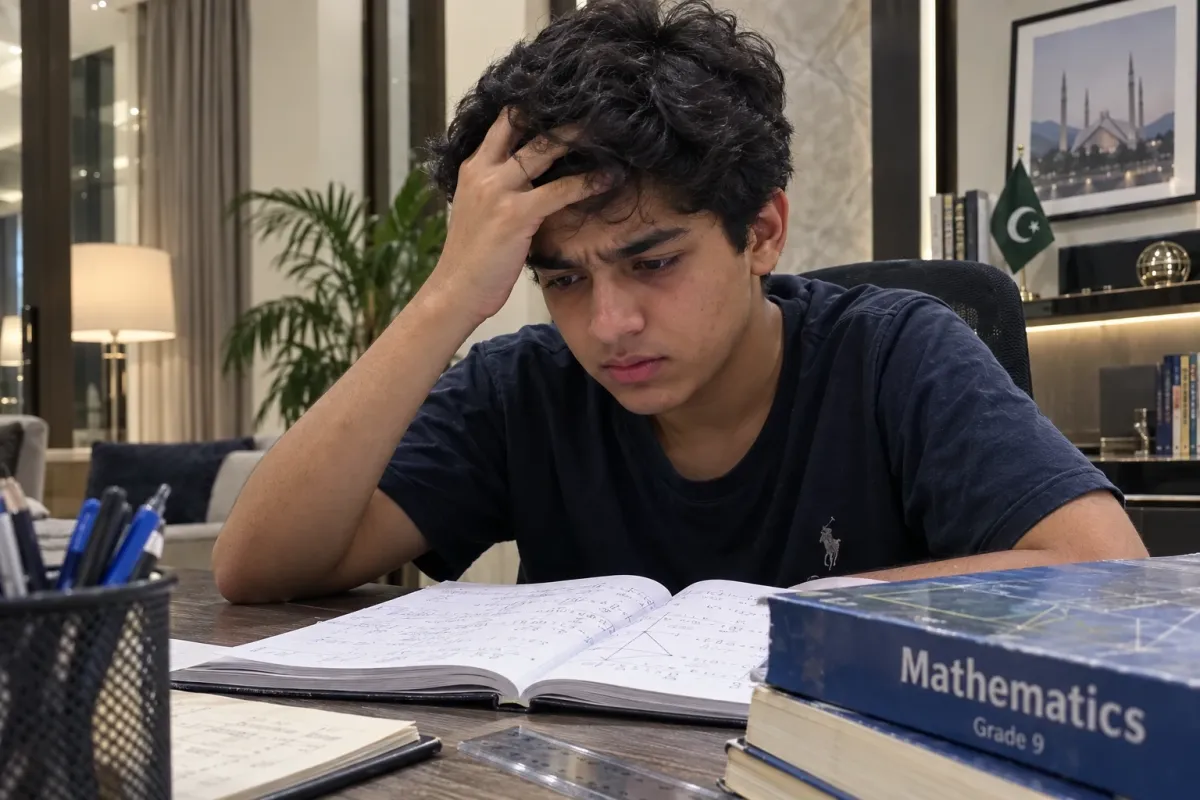
It happens in almost every home. The maths copy is open on the table. Your child pushes it away, sits back, and says the words you dread: "Mujhse math nahin hota." I can't do math. For a parent it sounds final, as if something is missing in the child forever. It is not. In almost every case, that sentence means one small thing has gone missing — and small things can be put back.
Let us keep this simple. There are only three real reasons a child freezes over a maths sum. Once you know which one it is, you know what to do.
1. The tables are slow
This is the biggest one, and the easiest to miss. Maths is a ladder. Every step stands on the step below it. If a child in Class 8 is stuck on factors, or a Class 9 student cannot do middle-term breaking, the problem is usually not the new chapter at all. It is that 7 × 8 still takes them three seconds to work out.
Think of the mind as a small table with space for only a few things at once. If the child must sit and count out 7 × 8 on their fingers, that little table is already full. There is no space left for the actual question. So the child stops — not because the chapter is too hard, but because their mind ran out of room before they even reached it.
Tables are slow → the child must calculate instead of remember → the mind fills up with small sums → no space left for the real question → the child freezes and says "I can't do math."
The first link in that chain is the only one you need to fix. Everything after it comes loose on its own.
2. The child is afraid
Sometimes the child is not stuck on the maths — they are stuck on the fear of the maths. A child who has been scolded for a wrong answer, or laughed at at the board, or given a red-marked copy in front of the class, will feel their heart beat faster the moment the maths copy opens.
This is not drama. Researchers who scanned children's brains during maths found that in anxious children the fear part of the brain lights up strongly while the thinking part quietens down. Fear takes the same space that thinking needs. A frightened child is not refusing to think — they are trying to think in a room that is already full of worry.
3. The child learned the steps, not the reason
Many children are taught only how to do a sum, never why it works. That is fine — until the exam question is worded a little differently from the one drilled in class. Then the child has nothing to fall back on. This is the cost of pure ratta: it works right up to the moment the question changes shape.
Nursery and Prep: Please Do Not Push
Many parents start early, thinking it gives the child a head start. A four-year-old is sat down with a copy and made to write tables or do sums, and is scolded when they cannot. Please do not do this.
At that age the front part of the brain — the part that holds several things in mind at once, follows steps in order, and sits still through frustration — is still in its earliest stage of growth. It keeps developing for many years yet. Asking a nursery or prep child to sit and do formal sums is like asking them to lift a weight their arms are not built for. They cannot do it, they feel they have failed, and the fear starts there — years before real maths even begins.
This does not mean keeping numbers away from small children. Early number sense matters a great deal. It just should come through play and talk, never through copies, drills and scolding.
Count the roti on the tawa. Count the steps up to the roof. Ask who has more toffees, you or me. Share five biscuits between two people and let them see it is not fair until each has the same. Let them count change at the shop. This is real mathematics, and their mind is completely ready for it. The copy can wait for Class 1.
Class by Class
The same weak spot wears a different face as the child grows. Find the face, and you find the fix.
| Stage | What you see at home | What is really missing |
|---|---|---|
| Class 1–4 | Counting on fingers, homework takes hours, panics at mental maths | Number sense and place value are weak; tables not yet learned |
| Class 5–8 | Struggles with fractions, minus numbers, word problems, first algebra | Tables 1–10 still slow; hard jump from numbers to letters like x |
| Class 9–10 | Freezes on factorisation, middle-term breaking, quadratics, physics formulas | The same slow tables, now buried under bigger chapters; steps memorised without meaning |
Look at the last column. It is nearly the same problem three times over, just older each time. A Class 9 student failing maths is very often a Class 4 gap that nobody caught.
Tables 1 to 10 — Nothing More
Parents often make children learn tables up to 20. There is no need. Tables 1 to 10 are enough, but they must be instant — as fast as saying your own name. A child who has to think for even two seconds does not yet know them.
And a child who does know them instantly gets a real gift in Class 9 and 10. When they see 56 in a factorisation question, 7 × 8 comes to mind at once. Middle-term breaking, taking out common factors, simplifying fractions, quadratics — all of it depends on spotting these pairs quickly. This is why a strong Class 4 student often becomes a strong matric student, with no extra talent involved.
Not one hour on Sunday. Three minutes, every day, before homework — asked aloud, in a calm voice, with no punishment for a wrong answer. Do one table at a time. Move to the next only when the first is instant.
Then add the reverse question, which is the real secret: instead of "what is 8 × 7?", ask "which two numbers make 56?" That is exactly the thinking Class 9 factorisation needs. You are preparing matric maths while your child is still in primary school.
Four Simple Steps
You do not need to know maths yourself to do this. You only need to stay calm and follow the order.
- Sit beside them, not across. Say: "Theek hai, koi baat nahin. Let us see where it got stuck." A calm voice removes the fear, and the fear was taking up the room they needed to think.
- Add one word: "yet." When they say "I can't do this," answer: "You can't do this one yet." One small word turns a closed door into a door not yet opened. Researchers have found that "not yet" makes children keep trying where "I can't" makes them stop.
- Find the exact step where it broke. Ask them to read the sum aloud to you, line by line, until they stop. Nine times out of ten they will stop at a small multiplication or a fraction — not at the chapter itself. Now you know what to fix.
- Give them one easy win before closing the copy. Go back to a sum they can already do and let them finish it correctly. Never let the copy close on failure. What a child remembers about maths at night is what they carry to school in the morning.
Do
- Three minutes of tables daily, calmly
- Say "not yet" instead of "you can't"
- Praise the effort, not the marks
- Treat a wrong answer as a clue
- End every session on a sum they can do
Don't
- Say "tumhara dimagh maths ka nahin hai"
- Compare with a cousin or classmate
- Push formal sums in nursery or prep
- Beat, shame, or shout over a wrong answer
- Solve it yourself just to end the crying
That first "don't" matters more than all the others. Many of us grew up hearing that some children are "maths minds" and some are not. It is not true, and the child who hears it stops trying that same day. Ability in maths is built by practice, the way strength is built by exercise.
When You Need a Hand
Sometimes the gap is four or five years old, and homework time at home is simply not enough to close it — especially when board exams are near and there is a whole syllabus still to cover. That is nobody's failure. It only means the child needs someone who can look carefully and say: here, this is the exact step that broke.
This is the work we do at Athens Academy. When a child joins us, we do not begin with the current chapter. We first find out where the ladder cracked — the missing tables, the shaky fractions, the concept from three classes ago that nobody noticed — and we close those gaps quickly, in small batches, without shaming the child for having them. Once the base is firm, the current chapters stop feeling impossible, and progress becomes surprisingly fast.
Alongside the classes, our online study portal gives your child clear notes and short, regular quizzes to practise on at home. It has been built with particular care for Class 9 and Class 10 mathematics — factorisation, middle-term breaking, quadratic equations and the rest of the matric syllabus — so a student can practise the same topic again and again, quietly, until it is truly theirs before the board exam arrives.
If your child has been saying "I can't do math" for a long time now, bring them to us. Let us find the gap together, and let us fill it while there is still time.
Start with tables 1 to 10. Three minutes a day. Stay calm. That is the whole beginning.
A child who says "I can't" is not shutting a door. They are showing you exactly where to begin.
Comments (1)
Small steps daily lead to big results, and filling the gap is what matters.